Pages

Showing posts with label Backwards map. Show all posts

Saturday, December 2, 2023

Bursts and Bubbles

The catalytic aspect of student learning my inquiry focused on this year was will a focus on spelling conventions foster an environment where word consciousness strengthens connections to the learning?

I identified this as my focus when I noticed while observing students from past years and noticing the actions of our learners this year stop writing completely as well as stop reading and avoid sharing back to the class when they lose the connection to words needed to continue to make sense of the learning. 

To build a rich picture of my students' learning I used T1 and T4 spelling tests, eAsttle writing samples and student voice.

The main patterns of student learning I identified in the profiling phase were the need of my students to expand their vocabulary and feel confident when they felt they wanted to use that word and know how to spell it or at least try to spell it. 

My profiling of my own teaching showed that I had strengths in co-constructing with my students to achieve what areas of vocabulary needed to be looked at to give them the courage to use new words.  But that my students would likely make more progress if I developed in committing to understand where they have come from and what their aspirations are going forward and how I can assist them in that.

The changes I made in my teaching were to listen to what my students wanted to learn and how they wanted to learn, rather than preconceived ideas of what I thought they needed to spell correctly. One major thing I have learnt is to ask for help if you find yourself lost throughout the inquiry process and break it down into smaller more manageable pieces.

The expertise that helped me what changes to make were conversations with Robyn Anderson.  One of the best pieces of advice she gave me after using a resource was to make it your own then you have ownership and understanding.

Overall I would rate the changes in student learning as they have more confidence within themselves to try new vocabulary.  The evidence for my rating is that their in class reading improved as well as their Probe scores, along with eAstle and Spelling test increases.

The most important learning I made about my focus of student learning was that there are many ways to skin a cat but the most effective way is to co-construct and have meaningful conversations. The most important learning I made about inquiry was that you might start at a certain point wanting to reach a certain point but it does not always work out that way. Change is good, and inevitable to be able to progress. Some learnings that would be relevant to other teachers are to ask for help when you need it and to be flexible with where you want your lessons to go.


Thursday, November 23, 2023

Teacher Inquiry 2023 Reflection


Inquiry Question: Will a focus on spelling conventions foster an environment where word consciousness strengthens connections to the learning?

Outcome 1: Increased awareness of vocabulary

Outcome 2: To approach new learning with confidence

Outcome 3: To understand spelling conventions

Intervention:

  • Students to complete spelling test (term 1/ term 4)

  • Use steps for consistent spelling tasks online.

  • Teacher modeling conventions so students see me modelling what I want to see them doing.

  • Create an word consciousness list that is visible.

  • Timetable opportunities for word consciousness with specific skills.

  • Introduce LS2 to specific designed conventions - teacher lead

  • Co-construct conventions lists and follow up activities - Listen to and act upon student voice

  • Encourage the use of new vocabulary when discussing familiar words.

  • Strengthen vocabulary connections to the area of learning 

  • Use visual clues to remember the conventions. 


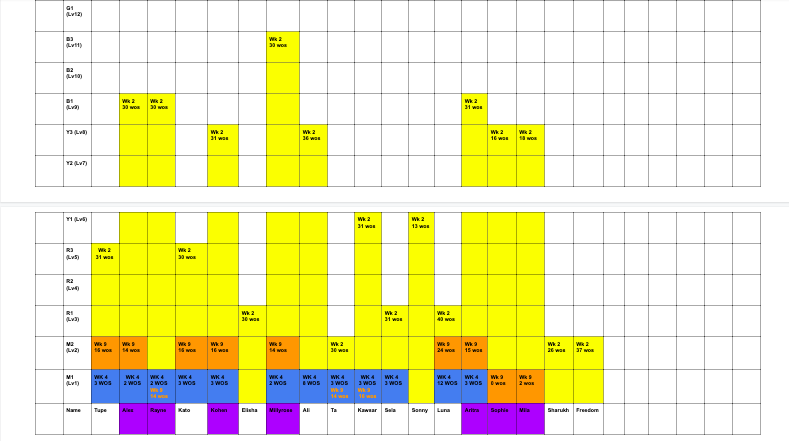
The darker highlights indicate that I feel I have meet these interventions to a good level, where the lighter highlights show that these interventions needed more consistency or more explicit teaching. I found that I didn't leave enough timetabled lesson time to effectively cover the interventions I was hoping to achieve higher outcomes in.

Teacher Learning:

  • Analysis spelling test (T1 to T4) - What has changed as a result of our intervention? What do we still need to do?

  • Professional readings to strengthen my connections to research findings.

  • Strengthen word consciousness by tabletiming opportunities for students to complete steps tasks.

  • Create scaffolds to show spelling conventions in a visual sense.

  • Co-construct with the learners a list of conventions


Here I have ticked all the boxes but I feel that I have not ticked them as many times as they needed to be. 
  • The testing was successful - my target group either stayed the same or increased their spelling, however they got some words wrong in the T4 test that they got right in the T1 test and vice versa. Maybe going through the test itself after it has been marked will allow the students to see where they are going wrong - sometimes its missing out by 1 letter or 2 letters around the wrong way. 
  • When it came to Professional Readings, some of the articles made me more confused than I was in the beginning, they just didn't seem to fit with what and how I was thinking. The outcome of this is the more professional readings I do the more they will align with my thinking and vice versa. 
  • Timetabling is something that happened but not always when it was meant to or how long it was meant to.  To change this I need to make sure everything is extremely prepared in both my mind and resources so no time is wasted.
  • Co-constructing with the learners was an integral part of my inquiry. Listening to what they had to say and discussing how that would work which was valuable.
Student Learning:

  • To attempt to use other vocabulary when writing.

  • Revisit and repeat the same spelling test to see if our word consciousness has made a difference.

  • To participate in the steps program

  • To participate actively in co-constructing a conventions list

  • To confidently use new vocabulary in their writing.

  • To understand the spelling conventions when writing unknown words.


My target group along with the rest of my students were amazing in taking on new learning. I think the biggest win was the conversations we had about words and how different words can come from words and how in some cases words from other languages even have close to the same sounding/spelling so they could also make that connection.

Measurable Outcomes:

  • Increased achievement between time 1/time 2 data 

  • Analyse changes in student responses in writing survey

  • Understand the spelling conventions.

  • Increased engagement in timetabled steps opportunities 

  • Increased confidence in using their new knowledge of spelling conventions in their writing.

My target group all increased in their writing and one has significantly increased and I believe that this is from the use of new vocabulary and her willing to show confidence in spelling this new language. Increasing their Steps usage has helped with their understanding of words and how they are used. As their teacher I need to change how to include more structured learning when it comes to the spelling conventions.

I feel the main thing is when I look back on my Teachers Inquiry is to ask for help when things get too overwhelming or when you just don't know where you are going or how you are going to get there.


Saturday, October 28, 2023

Describing and Explaining the changes or tweaks I have made in my practice along the way.

 Describing and Explaining the changes or tweaks I have made in my practice along the way.

Inquiry question: Will a focus on spelling conventions foster an environment where word consciousness strengthens connections to the learning?


My Thought Process

When I first undertook this inquiry it was to enable my students to have the confidence to be able to use the language the student wanted to use in their writing. In discussions with Robyn Anderson she had also noticed the same scenario within her groups, so we decided we would do a shared Teachers Inquiry. As we shared the classroom this made sense, however activities that were implemented in her groups did not translate in my groups and vice versa.  As a consequence we shared the focus but our implementation was individualised.  


Initial Thoughts of How I Could Achieve My Goal

I was under the naive impression that changing the students confidence in spelling and new language could be done by phonics and 'everyday rules' of spelling conventions.  This however was not the case.  I implemented the use of our school's Steps program ensuring it was timetabled each day as well as entering specific words we were looking on top of their assigned Steps work.  

While Robyns groups were working with affixes and suffixes we were working with beginning phonemes eg ph and f.  After looking at some examples of how that would work, I designed a form for my year 7/8 year group. I thought this would aide in my Teacher Inquiry but it didn't. I had once again over thought what my students needed and put too much on the task sheet and it became too confusing (not only for my students but for myself). 

Changes and Tweaks

I needed to make a few tweaks to the task to enable it to be an effect resource for my students.  This worked for part of the task but not the whole task. My students wanted to learn, but they wanted to learn words not the sounds of the words because they had already done that in the journers. So back to the drawing board, we played a form of a game. I choose a letter we would work with and gave a few examples of high-frequency words and the groups then added to those words by calling out words they knew starting with the same letter - this not only worked but was fun and gave the students some confidence that they knew more words than they thought they did and they could spell them too which was a bonus.

Children must learn to spell some “high-frequency” words conventionally if writing competencies are to develop (Croft, 1983). These high-frequency words are best learnt as a component of writing and not as a result of studying isolated lists of words as this enables teaching that is responsive to the individual child (Croft, 1983). Developmentally, children should be learning to spell words they almost know. These words will fall naturally within the child’s zone of proximal development, which refers to the gap between what a child can do independently and what can be achieved with the help of a teacher (Wood, 1988).


Language Experience

A change in my practice was recognising that when I was having conversations with my students they were taking on board new language that was in our conversations and I was making new discoveries about my students - making stronger connections to their worlds, therefore enabling me to change how I plan my lessons.  

Ashton-Warner (1963) referred to the conversation between the teacher and the child as a “passionate interchange of talk” (p. 66), saying, “I reach a hand into the mind of the child, bring out the stuff I find there, and use that as our first working material” (p. 34). 

At times I think I have taken for granted that the students prior knowledge would have included some of the language we were reading as some of it was what I would consider 'everyday talk'.  I had to change how I was having conversations to think explicitly about what was being said and how I could use that information to inform my planning decisions. 


Changing my Target Group

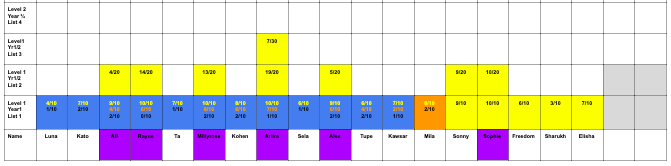
Looking at Time Point 4 it came apparent that one of my target group did not have the correct data for me to analyse.  I decided to take that student out of my numbers which in turn changed my data. Time Point 1 and 2 Data.   


Language Experience: Teaching for the Integration of Early Literacy Learning by Using What Children Know to Develop Active Problem Solving

Friday, July 28, 2023

Intervention: implementation & monitoring of new approaches


Intervention: implementation & monitoring of new approaches 

The 'worksheet' I had designed for my students to enhance their knowledge of how words are connected involved using phonemes that have the same sound, pictures to visibly see the difference of the sound, both familiar and unfamiliar words, an opportunity to define the words as well as being able to look for new words themselves.  Below on the left is my original worksheet and on the right the learners full in the rest of the words themselves and find the root words.  We had to do a lot of unpacking and defining for understanding so my students felt confident in finishing the worksheet. A teacher intentionally calls attention to specific vocabulary terms which heightens the student’s awareness of the new words heard or read (Manzo & Manzo, 2008).

After reflection of my initial concept of designing a word list to show the differences and similarities of phonemes, I realised that my students were still struggling with the beginning of the given words.  While having discussions in the talanoa time it was suggested that I not only make the words visible to my group but to also place a sound bite on each word so that my learners could hear the word.  The fifth framework suggests involving students in original investigations of word and word features.  (Ashlie R. Jack, 2011). When I was discussing how I was going to alter the way I would be doing the word sheet to my students, it then dawned on me that as well as working alongside words the students had searched to expand their knowledge they could place a sound bite on those words so I could navigate their learning by hearing if they are pronouncing each sound correctly that would enable them to have an understanding of how the word sounds as well as being conscious of how the word is spelt. 

With monitoring the trajectory of the understanding the students have with words they have been introduced to and observing how they have the confidence to look up new words to ensure they have not only the spelling correct but also an understanding of the definition given.  

I have really changed my thinking of the teacher teaches the unknown, to the teacher and students co construct through discussions or informal feed forward and feedback of what works for them and which words, sounds, chunks etc  they have difficulty with.


Wednesday, June 28, 2023

Causal Chain 2023 - Teacher Inquiry


My inquiry this year is to see if a focus on spelling conventions foster an environment where word consciousness strengthens connections to the learning? By creating a causal chain this helped me see what I wanted to focus on, where I was and where I wanted to end. This then helped me fill in the chain with my thought processes, data, strategies, interventions and outcomes. In short what is the purpose of my Teacher Inquiry and how can I change my teaching to foster the desired outcome. Working backwards in the map allows you to have a vision and work out step by step how you could get there. It is important to know that not everything will work but when that happens it is a learning opportunity, an opportunity to change your thinking and teaching practice and move on to the next strategy or intervention to get you closer to your inquiry focus.

My Causal Chain (backward map) is shown below.

Robyn and I are doing a collaborative inquiry as we share a class. We have the same vision but we have different groups of learners which means our approach is different yet aligned. We have noticed the same behaviour overall from our learners. When writing they revert to words they either know or can spell rather than expanding their vocabulary by using unfamiliar words. Our hunch is that if our learners have opportunities to have a timetabled sessions of Word Consciousness - understanding the connections of the words, the chunks, decoding the words and spelling conventions, the learners will gain the confidence to begin to use the 'new' words with confidence in their everyday learning.


Tuesday, September 13, 2022

Causal Chain - Term 3 update


Inquiry Focus: Will a focus on Reading for Enjoyment increase student efficacy and capability in Reading?

Reaching Term 3 and reflecting back on our inquiry has been quite eye opening in the way that Reading for Enjoyment (RFE) has infiltrated our students. I have noticed that there has been an increase in not only their reading ability and capability but also in their confidence when talking about reading and books. This increased vocabulary knowledge has aided with the students understanding of not only 'reading' but with all the curriculum subjects.

One of my goals from last term was to ensure the students saw me as one of their teaches read, so when we were RFE we were ALL RFE. At first as teachers we would remind our students that it was RFE time, now the students remind me.

A noticeable difference is that not only is the new vocabulary used but the self-efficacy to utilise that body of newly acquired words in their speeches.


Friday, November 20, 2020

Teacher Inquiry Backwards Map 2020

Will comprehension increase if the opportunity to focus and notice

syllables and sounds are provided?


I want my students to see that learning used in one area can be transferred to another if I help them make links with vocabulary, instruction and strategy. 


How I changed my teaching practice was by increasing the time I spend on phonics and how I approached the teaching format.

I introduced a puppet that the students named 'Blippy', this assisted in the process of see, say, do. I built on the learners prior knowledge and increased teacher modelling - repeat back to me - check and using phrases to make connections with the students comprehension.


Spelling banks has been a fun way to increase the learners word knowledge and comprehension - the students get to write as many words as they know in a certain time, they get points if the words are correct as well as if they have sounded out the words and have some letters correct. This has become a peer competition game that they support and scaffold each other in.


From assessments I can see the shifts in both reading and spelling, this shows me that the focus of my Teacher Inquiry has been beneficial and with the planning and teaching changes I made are justified and shown in the data.  


Running records
Spelling assessment

I will continue to reflect on my teaching practices and teach authentic contexts that the students can connect with.


The biggest change in my practice is recognising when and where the opportunities for explicit teaching are within a lesson.

Thursday, August 29, 2019

Backwards Mapping of Teacher Inquiry

Looking at my learners and where they were at, I made the decision to have my inquiry look at how I could raise my learners achievement by them feeling confident about knowing the essential spelling words. As shown below in my Backward Mapping diagram. 


Target student word knowledge has improved but connections between these words and reading are not there. Target students know words in isolation but are not yet able to use in an independent reading/writing context. Observations of Anna Salmon (PBS Reading Recovery teacher) have allowed me to introduce several activities to help my students make the connections in independent reading/writing contexts. Data analysis has been ongoing and maps current progress. This is particularly useful when I refer back to my original backwards map.
  • These are some of the changes I have made in my practice because of my teacher inquiry:
  • Introduction of visual scaffolds (eg: flash cards) used across curriculum areas
  • Teacher modelling of language that students are to use in writing and strategies such as searching for words on alphabet card and sound out).
  • Implemented Reading Recovery word knowledge strategies (eg: drop counters in cup when hear sound/letter shapes)
  • Timetable changed to cater for late students
  • Phonics
Going forward after talking to our PBS Col - Robyn Anderson I will be implementing these activities for learners at school and home as ways to make the connections:
  • Kete talanoa
  • Heather Collins
  • Word jigsaw to introduced as part of guided session and home reading activities