Pages

Showing posts with label Teacher inquiry. Show all posts

Thursday, November 23, 2023

Teacher Inquiry 2023 Reflection


Inquiry Question: Will a focus on spelling conventions foster an environment where word consciousness strengthens connections to the learning?

Outcome 1: Increased awareness of vocabulary

Outcome 2: To approach new learning with confidence

Outcome 3: To understand spelling conventions

Intervention:

  • Students to complete spelling test (term 1/ term 4)

  • Use steps for consistent spelling tasks online.

  • Teacher modeling conventions so students see me modelling what I want to see them doing.

  • Create an word consciousness list that is visible.

  • Timetable opportunities for word consciousness with specific skills.

  • Introduce LS2 to specific designed conventions - teacher lead

  • Co-construct conventions lists and follow up activities - Listen to and act upon student voice

  • Encourage the use of new vocabulary when discussing familiar words.

  • Strengthen vocabulary connections to the area of learning 

  • Use visual clues to remember the conventions. 


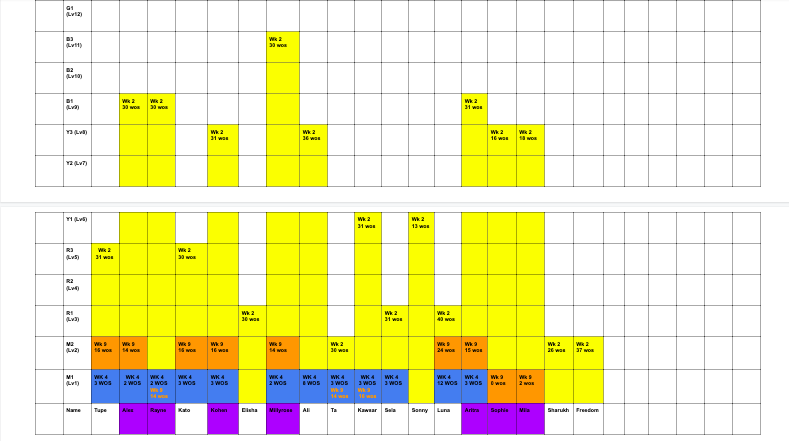
The darker highlights indicate that I feel I have meet these interventions to a good level, where the lighter highlights show that these interventions needed more consistency or more explicit teaching. I found that I didn't leave enough timetabled lesson time to effectively cover the interventions I was hoping to achieve higher outcomes in.

Teacher Learning:

  • Analysis spelling test (T1 to T4) - What has changed as a result of our intervention? What do we still need to do?

  • Professional readings to strengthen my connections to research findings.

  • Strengthen word consciousness by tabletiming opportunities for students to complete steps tasks.

  • Create scaffolds to show spelling conventions in a visual sense.

  • Co-construct with the learners a list of conventions


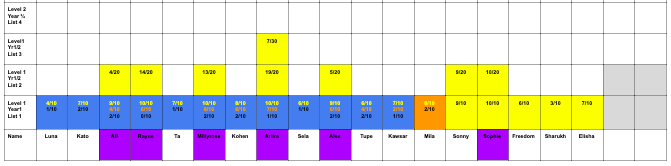
Here I have ticked all the boxes but I feel that I have not ticked them as many times as they needed to be. 
  • The testing was successful - my target group either stayed the same or increased their spelling, however they got some words wrong in the T4 test that they got right in the T1 test and vice versa. Maybe going through the test itself after it has been marked will allow the students to see where they are going wrong - sometimes its missing out by 1 letter or 2 letters around the wrong way. 
  • When it came to Professional Readings, some of the articles made me more confused than I was in the beginning, they just didn't seem to fit with what and how I was thinking. The outcome of this is the more professional readings I do the more they will align with my thinking and vice versa. 
  • Timetabling is something that happened but not always when it was meant to or how long it was meant to.  To change this I need to make sure everything is extremely prepared in both my mind and resources so no time is wasted.
  • Co-constructing with the learners was an integral part of my inquiry. Listening to what they had to say and discussing how that would work which was valuable.
Student Learning:

  • To attempt to use other vocabulary when writing.

  • Revisit and repeat the same spelling test to see if our word consciousness has made a difference.

  • To participate in the steps program

  • To participate actively in co-constructing a conventions list

  • To confidently use new vocabulary in their writing.

  • To understand the spelling conventions when writing unknown words.


My target group along with the rest of my students were amazing in taking on new learning. I think the biggest win was the conversations we had about words and how different words can come from words and how in some cases words from other languages even have close to the same sounding/spelling so they could also make that connection.

Measurable Outcomes:

  • Increased achievement between time 1/time 2 data 

  • Analyse changes in student responses in writing survey

  • Understand the spelling conventions.

  • Increased engagement in timetabled steps opportunities 

  • Increased confidence in using their new knowledge of spelling conventions in their writing.

My target group all increased in their writing and one has significantly increased and I believe that this is from the use of new vocabulary and her willing to show confidence in spelling this new language. Increasing their Steps usage has helped with their understanding of words and how they are used. As their teacher I need to change how to include more structured learning when it comes to the spelling conventions.

I feel the main thing is when I look back on my Teachers Inquiry is to ask for help when things get too overwhelming or when you just don't know where you are going or how you are going to get there.


Friday, July 28, 2023

Intervention: implementation & monitoring of new approaches


Intervention: implementation & monitoring of new approaches 

The 'worksheet' I had designed for my students to enhance their knowledge of how words are connected involved using phonemes that have the same sound, pictures to visibly see the difference of the sound, both familiar and unfamiliar words, an opportunity to define the words as well as being able to look for new words themselves.  Below on the left is my original worksheet and on the right the learners full in the rest of the words themselves and find the root words.  We had to do a lot of unpacking and defining for understanding so my students felt confident in finishing the worksheet. A teacher intentionally calls attention to specific vocabulary terms which heightens the student’s awareness of the new words heard or read (Manzo & Manzo, 2008).

After reflection of my initial concept of designing a word list to show the differences and similarities of phonemes, I realised that my students were still struggling with the beginning of the given words.  While having discussions in the talanoa time it was suggested that I not only make the words visible to my group but to also place a sound bite on each word so that my learners could hear the word.  The fifth framework suggests involving students in original investigations of word and word features.  (Ashlie R. Jack, 2011). When I was discussing how I was going to alter the way I would be doing the word sheet to my students, it then dawned on me that as well as working alongside words the students had searched to expand their knowledge they could place a sound bite on those words so I could navigate their learning by hearing if they are pronouncing each sound correctly that would enable them to have an understanding of how the word sounds as well as being conscious of how the word is spelt. 

With monitoring the trajectory of the understanding the students have with words they have been introduced to and observing how they have the confidence to look up new words to ensure they have not only the spelling correct but also an understanding of the definition given.  

I have really changed my thinking of the teacher teaches the unknown, to the teacher and students co construct through discussions or informal feed forward and feedback of what works for them and which words, sounds, chunks etc  they have difficulty with.


Monday, July 18, 2022

Causal Chain 2022

Causal Chain - Reading for Enjoyment

This year my teaching partner Robyn Anderson embarked on a crusade (which I jumped on board) to get our students to increase their reading.  The inquiry was not just to focus on reading but getting the students to read for enjoyment. We wanted to find out if a focus on Reading for Enjoyment increase student self efficacy and capability in Reading?  The first step was creating a causal chain which helps you to stay focused on the purpose of your teacher inquiry. It is so easy to lose focus along the way so having a causal chain to look back on helps to keep you on track. After RA had done some research along with our shared discussions on how we could increase our classes reading practices or lack thereof, we noted that to develop reading for pleasure habits in students we need a collective and collaborative approach that allows our tamariki to see role models at school and at home who value reading. 

Looking back at my causal chain I realise my students are seen as readers through our Leaders in the Library initiative, through sharing reading tips at our school assemblies and by actively reading for enjoyment in the classroom. It is important that our learners see themselves as readers too so we have made a point of capturing all of this in photos which are clearly displayed in our classroom. However when I look back at my causal chain I can see that because Robyn or myself is always taking photos I have not been allowing my learners to consistently see me as a reader. As we approach Term 3 I know exactly what my goal is... make sure my learners see me as a reader too.


Link to causal chain

Tuesday, May 24, 2022

Leaders in the Library


Implement and Try #1: Leaders in the Library...

Last week during Robyns weekly catch up with our student leaders, they discussed ways they can inspire others to read for enjoyment. After talking through a couple of a suggestions they all decided one way they could do this was to offer a weekly lunchtime reading opportunity. The plan is to invite one class a week on a Monday to join the leaders in the library for story time. There is no formal plan as they want this to be organic and evolve naturally.

To set ourselves up for success we introduced the Leaders in the Library idea to the school at our weekly assembly. Room 7, our Year 2 students were the first class to be invited. Even though I'm pretty sure they didn't fully understand, Room 7 were very excited to hear they had been chosen as the first class to take part. To keep the momentum going we will be announcing the name of the class who will be invited to join us each week at assembly. 


Fast forward to today... The students of Room 7 were invited to join our Leaders in the Library group for story time. Some students wanted to have a story read to them 1:1, some preferred having a story read to them with their friends in the same small group, and others want to read the book to one of our leaders themselves. As teachers our total input to this initiative was to unlock the library and take photos. Our amazing student leaders took control and created the most welcoming and relaxing reading environment. When Robyn walked back into the library after chatting to a colleague she saw one of our Year 8 students helping one of our younger learners to choose a book. She was asking him all sorts of questions to understand what type of story he enjoyed so she could help him choose the 'perfect' book. Dotted all over the library were pairs or small groups of Year 2 students enjoying exploring stories with our Year 8 students. What truly amazed us even more was that apart from the murmur of the reading together session, there was absolutely no need for any behaviour reminders. All the students who were there wanted to be there. 

A shared love of books was the connection these students had today despite being a number of years apart in age. We did have to smile at our class who decided after reading the books they would have low key 'learning conversations' with their new reading buddies to check their understanding of the story and talk about the characters. We are excited to see where this goes as the experience was empowering for everyone involved.  


Friday, April 8, 2022

Establishing the foundations to go forward with formal learning.

Student engagement by establishing foundations to go forward with formal learning was chosen as our whole school inquiry at our TOD in February. During our syndicate meeting our COL teacher Robyn Anderson asked us questions regarding how it was for us as teachers and our students coming back to school and establishing our class routines after being out of the classroom for an extended period of time.

Going back into the classroom after the Covid-19 lockdowns was like walking into the unknown, not only did we have to wear masks all day but everyday we didn't know how many of our students were going to come, if the same students would come each day. Our attendance was very erratic, but we were determined to give the students present the opportunity to learn. Right away Robyn and I decided we had to just do what we know to do best and that is teach the students that are there and meeting their needs.

Establishing connections with the students which in turn increases engagement was a priority. We did this by starting formal learning from day 1. Ensuring there was a familiar routine and structure seemed to work well for the students that were present. Having face to face interactions with classmates was important. Robyn and I continued with what was working for our class pre lockdowns, which was pair/group discussions. At first there was a bit of apprehension, the reality was that many of the students had not engaged with online learning since August 2021. We scaffolded them through formal learning conversations, which in turn lent to them forming bonds with each other then passing that knowledge on to students that joined at a later time. Working collaboratively gave the learners a sense of belonging.

Our class mantra whether attending lessons in the classroom or online is to 'keep our learning going'. Establishing foundations by sharing our expectations as well as ensuring the learners knew the purpose of the tasks, rather than doing work for the sake of working, kept the students engaged and focused. Robyn and I began Hybrid teaching - in class teaching and online learners in the class interacting with not only the teachers but working collaboratively in groups for example by having Google meets with breakout rooms with their reading groups.

Keeping to our timetable no matter where the learning was has meant that everyone knew the expectations to have their work finished and placed on the finished worksheet. This way the online learner still had visible work in the classroom. One change that Robyn and I made was to ensure our DLOs aligned so that they all looked the same but more importantly had the same message no matter what level they were targeted at. A change that proved to be a game changer when I was forced to isolate and Robyn needed to keep the learning going in the room.

In these uncertain times we have to be more flexible with how we are teaching aka hybrid and an unpredictable roll. Robyn and I are continually reflecting and having professional and informal conversations about student engagement by establishing foundations and continuing to go forward with formal learning to 'keep our learning going' no matter where that learning is done, as long as the students are engaged and working with a purpose.

To view Robyn Anderson's blog Powerful Peers.


Friday, November 20, 2020

Teacher Inquiry Backwards Map 2020

Will comprehension increase if the opportunity to focus and notice

syllables and sounds are provided?


I want my students to see that learning used in one area can be transferred to another if I help them make links with vocabulary, instruction and strategy. 


How I changed my teaching practice was by increasing the time I spend on phonics and how I approached the teaching format.

I introduced a puppet that the students named 'Blippy', this assisted in the process of see, say, do. I built on the learners prior knowledge and increased teacher modelling - repeat back to me - check and using phrases to make connections with the students comprehension.


Spelling banks has been a fun way to increase the learners word knowledge and comprehension - the students get to write as many words as they know in a certain time, they get points if the words are correct as well as if they have sounded out the words and have some letters correct. This has become a peer competition game that they support and scaffold each other in.


From assessments I can see the shifts in both reading and spelling, this shows me that the focus of my Teacher Inquiry has been beneficial and with the planning and teaching changes I made are justified and shown in the data.  


Running records
Spelling assessment

I will continue to reflect on my teaching practices and teach authentic contexts that the students can connect with.


The biggest change in my practice is recognising when and where the opportunities for explicit teaching are within a lesson.

Sunday, July 26, 2020

The Literacy Place - Reading PD

 This reading PD was a whole school PD which covered all ages/years.


Reading over laps all curriculum areas, thus making it imperative that the learner understands what they are reading to increase their knowledge of the curriculum area we are working within.

Learners need to have the ability to read multiple types of texts and understand what those texts are conveying.  As a teacher I feel it is my duty to expose the learners to as many forms of text available to enable them.  Exposer to these texts can be covered in the three types of lessons as shown below left.  Exposer to all texts includes some resources that I previously had not classed as texts that are relevant to learners or explicit teaching.  Multiple texts that could be utilised are as below.


Scaffolding the learners to be confident in recognising and understanding words in multiple texts is crucial when supporting my learners to become independent on their journey to be  confident proficient readers.

Learners needs these steps to be effective readers and understanders. 

These are strategies that I use with my groups but implementing the visual cues will benefit the learners - this could be used on their iPads as a visual cue to refer to when reading

Shared reading is an opportunity to see the shifts in the students.  Once they have the structured tools to prompt them where to go to next they feel confident in making that move towards the next level when they are ready.


Using the comprehension strategies solidifies where each leaner is and where they need to go next.  Having the strategies visible it aides in sifting out the missing link as to why the student hasn't made a shift.


Thursday, August 29, 2019

Teacher Inquiry Focus

My inquiry focus is to be more aware if strengthening the students connection to the essential words will not only increase words knowledge but also their comprehension.

I am focusing on a core group of 5 students, both male and female.   

These students have found it challenging to recall the list of 10 essential words.  With the use of different strategies and deliberate focus on the essential words there has been a marked progress from the first round of testing.


BTGSBCBSGM
a
1
1
1
1
1
i
1
1
1
1
1
it
2
1
1
1
1
in
2
1
1
1
1
my
2
3
1
1
1
to
1
2
4
1
1
we
3
2
2
the
3
3
1
1
1
was4
and
3

Backwards Mapping of Teacher Inquiry

Looking at my learners and where they were at, I made the decision to have my inquiry look at how I could raise my learners achievement by them feeling confident about knowing the essential spelling words. As shown below in my Backward Mapping diagram. 


Target student word knowledge has improved but connections between these words and reading are not there. Target students know words in isolation but are not yet able to use in an independent reading/writing context. Observations of Anna Salmon (PBS Reading Recovery teacher) have allowed me to introduce several activities to help my students make the connections in independent reading/writing contexts. Data analysis has been ongoing and maps current progress. This is particularly useful when I refer back to my original backwards map.
  • These are some of the changes I have made in my practice because of my teacher inquiry:
  • Introduction of visual scaffolds (eg: flash cards) used across curriculum areas
  • Teacher modelling of language that students are to use in writing and strategies such as searching for words on alphabet card and sound out).
  • Implemented Reading Recovery word knowledge strategies (eg: drop counters in cup when hear sound/letter shapes)
  • Timetable changed to cater for late students
  • Phonics
Going forward after talking to our PBS Col - Robyn Anderson I will be implementing these activities for learners at school and home as ways to make the connections:
  • Kete talanoa
  • Heather Collins
  • Word jigsaw to introduced as part of guided session and home reading activities